
Student Screen Time Is Under the Microscope: Does Your District Have the Data?
How Linewize EdTech Manager helps K–12 leaders measure screen time, evaluate app usage, strengthen governance, and make smarter technology decisions.
School districts have more digital tools than ever before—learning platforms, assessment programs, intervention tools, curriculum resources, communication apps, productivity suites, and supplemental subscriptions.
But when budget season, renewal time, or a school board conversation arrives, many leaders still face a deceptively simple question: What is actually happening on district devices?
A list of purchased licenses cannot show whether a tool is being used, where adoption is strongest, how much time students spend in each application, or whether an unapproved app is creating a privacy concern. Districts need evidence—not estimates.
Five Questions Every District Should Be Able to Answer
- How much time are students spending on district devices?
- Which applications account for that time?
- Is usage happening at school, at home, or both?
- Are purchased tools being adopted across every school?
- Are applications approved, secure, and worth renewing?
Screen Time Is Becoming a Policy Issue
The conversation about student screen time is no longer limited to families and educators. State lawmakers are increasingly examining how technology is used in K–12 schools.
Linewize’s state-by-state tracker, updated July 20, 2026, identifies enacted, proposed, stalled, and inactive legislation addressing issues such as instructional screen time, school-device use, technology policies, privacy protections, and parent access. View the current state-by-state screen-time legislation guide.
For Tennessee districts, the issue is especially timely. The state has enacted legislation emphasizing teacher-led instruction in kindergarten through fifth grade, with digital tools serving a supporting role.
From “We Think” to “The Data Shows”
Linewize EdTech Manager brings student screen time, district-wide application usage, licensing, spending, adoption, privacy, and compliance information into one platform.
Instead of relying on surveys or anecdotes, district leaders can explore actual usage by district, school, grade, class, teacher, student, and application. That detail can reveal patterns a district-wide total may hide.
A platform might appear successful overall while seeing strong adoption at one campus and limited use at another. That difference may point to a training need, an implementation challenge, an access issue, or simply a tool that is not the right fit for every setting.
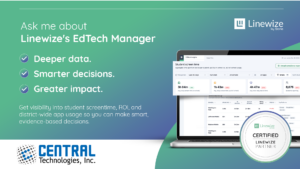
Linewize EdTech Manager provides visibility into screen time, ROI, and district-wide application usage.
Understand Student Screen Time in Context
A single total does not tell the whole story. EdTech Manager can help districts examine average daily screen time by district, school, grade, and individual student while separating in-school activity from out-of-school use.
That allows leaders to move beyond “How much screen time?” and ask better questions:
- Which applications account for the greatest share of daily use?
- Does device use vary significantly between schools or grade levels?
- Are students engaging with district-assigned learning tools during instructional time?
- Is a meaningful portion of device activity occurring outside school?
- Where might a closer review or targeted conversation be appropriate?
The Share of Screen Time report can also show which applications are driving usage, giving technology leaders evidence for planning, reporting, and renewal discussions.
Spend Smarter
Identify unused, expired, or low-usage licenses before renewal decisions are made.
Strengthen Governance
Review app approvals, privacy agreements, security vetting, and changing risk information.
Support Adoption
See where tools are succeeding and where schools or educators may need additional support.
Make Smarter Renewal and Budget Decisions
A license may be available to thousands of students—but availability does not equal adoption. EdTech Manager helps districts identify unused, underused, expired, or low-usage applications and compare adoption across schools and application categories.
This is not simply about cutting costs. It is about protecting the tools that deliver value while identifying spending that can be redirected toward higher-priority needs. When decisions are supported by actual usage data, technology leaders can have more productive conversations with curriculum teams, finance departments, administrators, and school boards.
Strengthen Application Privacy and Governance
Every new application can introduce questions about approval, student data, privacy, and security. EdTech Manager provides visibility into the district’s app inventory and approval status, helping teams identify heavily used unapproved applications, review third-party security vetting, and respond when an app’s security status changes.
Districts can also track data privacy agreements in one location. Together, these capabilities create a clearer process for understanding which apps are present, whether they are approved, how widely they are used, and which documentation is on file.
Improve Adoption Without Turning Data Into a Scorecard
Sometimes a district has selected the right tool, but implementation is uneven. Adoption data can help instructional technology and professional learning teams identify where more support is needed, recognize strong implementation, and replicate successful practices across schools.
The goal is not to use application data as a punitive scorecard. It is to use evidence as a starting point for better support, more equitable implementation, and stronger technology planning.
See What Your District Data Reveals—At No Cost
Qualifying U.S. schools can participate in a no-cost, two-week EdTech Audit with limited technical setup.
Use the results to help guide technology strategy, budget decisions, application governance, and future planning.
Ready to See What Your District’s Data Can Reveal?
Contact Central Technologies to discuss Linewize EdTech Manager or the no-cost EdTech Audit.

